Nalanda: a positive model of admission control
In classical and popular usage, a gatekeeper is not necessarily a censor. In the Nalanda example, the gatekeeper is described as an intellectual threshold: a role that protects entry into a demanding learned tradition, checks preparation, and thereby maintains communal standards (discussion of gatekeepers at Nalanda University).
For peer review, this positive model is a useful control. Legitimate gatekeeping is possible when criteria are visible, proportional to scholarly quality, and open to strong but unconventional submissions. The illegitimate version begins where standards are replaced by closed access, nepotism, favoritism, or penalties for peripheral status and missing institutional affiliation.
Where the positive function may disappear
In the stronger but still testable version of the hypothesis, the senior generation is not merely defending standards; it may be excluding unusually visible middle-generation participants after they have already accumulated their own network connectivity and methodological independence.
- Nepotism and favoritism: if programme composition is better explained by proximity to the organizing circle than by proposal quality, the positive function of gatekeeping weakens.
- Unconventional methods: corpus data and digital methods may be filtered not because they are unscientific, but because the committee is unable or unwilling to evaluate their value; the Gasuns case should be tested in this frame.
- Periphery and affiliation: a researcher without a recognizable institutional shield may be vulnerable for reasons unrelated to scholarly quality.
- Pseudoscience as a weak explanation: if the submission procedure is hidden and external participants do not know how to enter the programme, filtering pseudoscience is unlikely to be the main selection mechanism.
- Double standard of rigor: a high scholarly bar cannot justify selection if senior or in-group participants are forgiven declining quality.
- Methodological purity: this may be a strong principle, but it is not proof by itself; even graduates of the Faculty of Asian and African Studies at St Petersburg University and other strong schools may violate their own methodological standards.
From hierarchy to distributed mediation
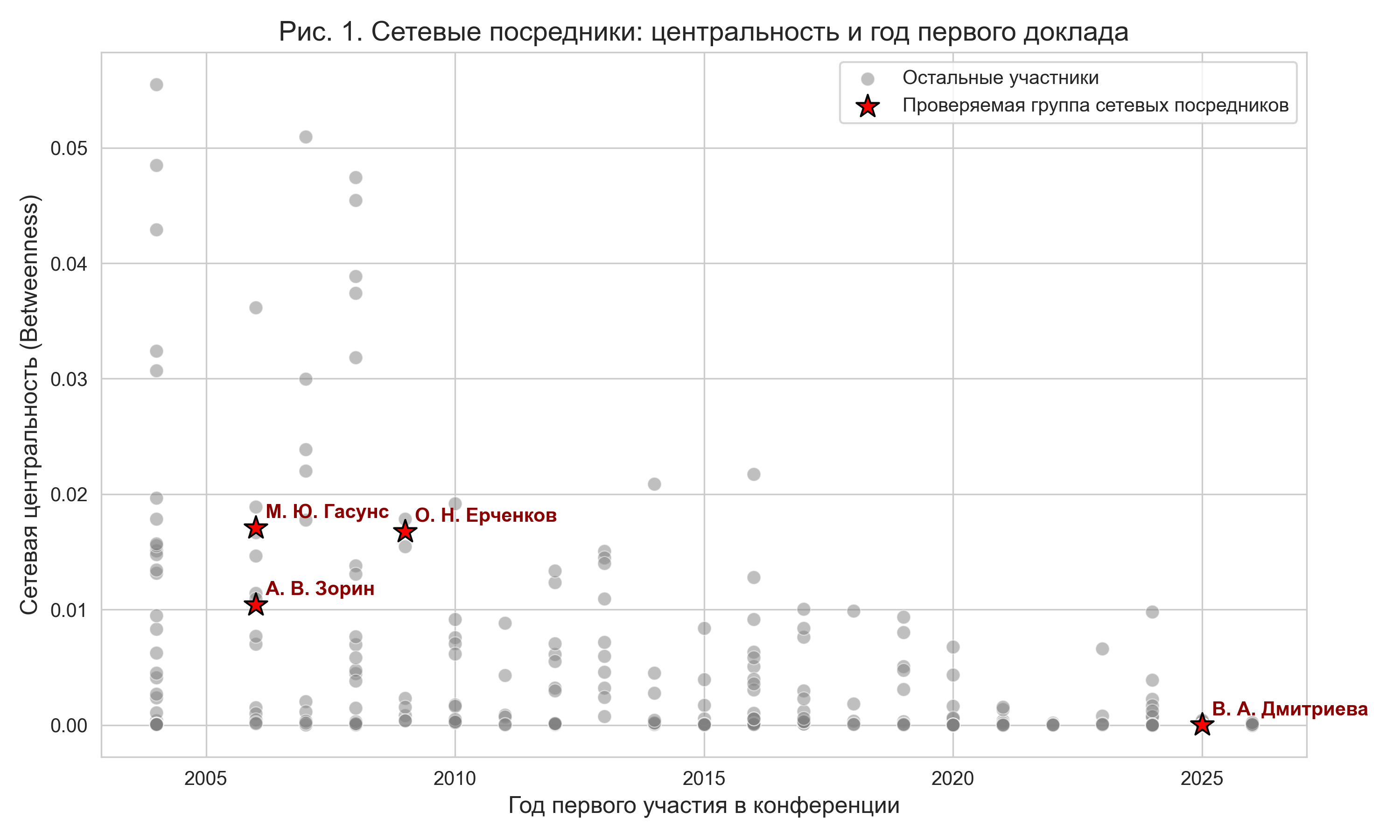
The archive allows us to discuss a generational shift: some of the field's connectivity is produced not only by vertical institutions, but also by horizontal network mediators.
Network mediators connect otherwise weakly linked clusters, initiate horizontal collaboration, and build venues outside a single RAS or classical-university affiliation.
Theoretical frame
- Field and symbolic capital: a conference programme is not just a schedule; it is also a mechanism of public recognition.
- Boundary work: programme selection may appear as disciplinary boundary maintenance while producing exclusion-like effects.
- Network communities: horizontal groups may remain active outside one venue and become less dependent on a local centre.
What is being tested
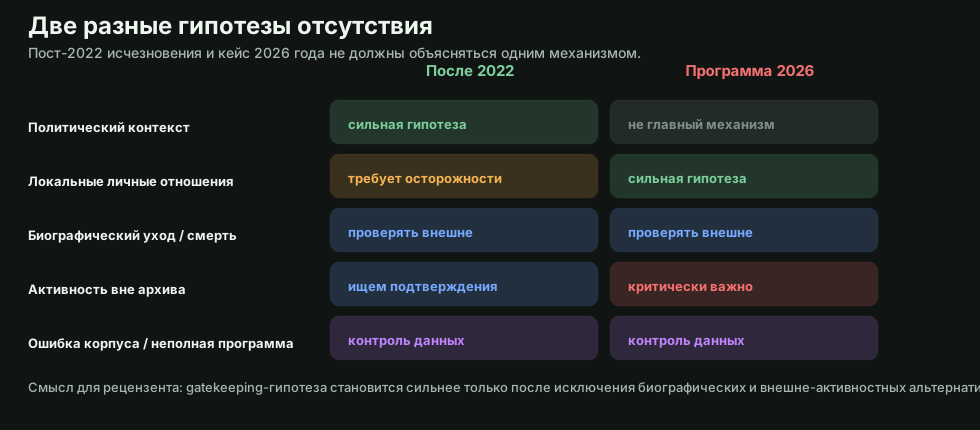
The 2026 case should not be mixed with post-2022 absences. Post-2022 absence may reflect the political context around Russia, emigration from Russia, or inability to participate from unfriendly countries. The 2026 case tests a different mechanism: local programme selection and personal relations inside the field.
Visualization and evidence
Betweenness centrality is used here not as a quality score, but as a measure of how often a participant links otherwise separate parts of the observed conference network.
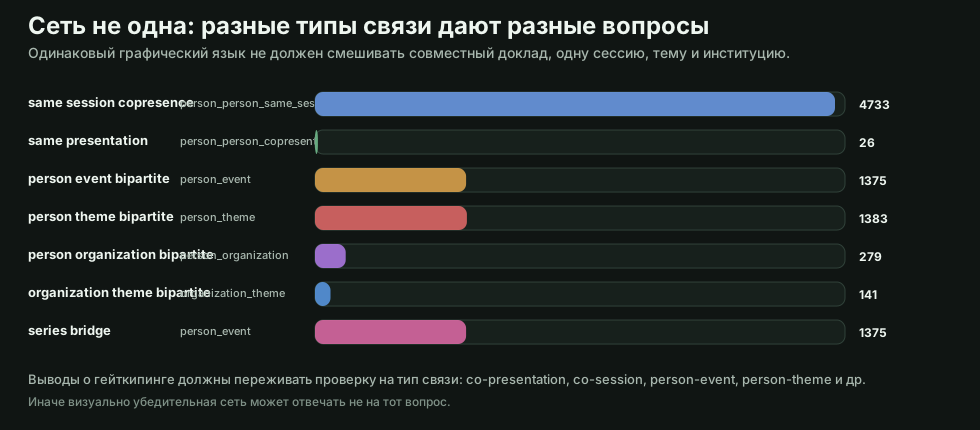
Several networks, not one
Joint presentation, same session, same topic, same event, and same institution answer different questions. The argument is stronger when these layers are kept separate.
The 2026 case
The 2026 case tests the synchronous absence of an active group: M. Gasuns, O. Erchenkov, V. Dmitrieva, A. Zorin, and Sizova as an additional identity-check row. Names are used for source auditability; the interpretation remains structural rather than personal.
The null hypothesis is simple: these authors may have reduced activity, shifted topics, not applied, or left the field. The institutional-filter hypothesis becomes stronger only if external sources show continuing activity while the programme loses a connective group.
A cautious peer-reviewable formula: "the observed configuration is compatible with an institutional-filter hypothesis, but does not prove motive; stronger claims require external evidence of continued activity and documented testing of alternative explanations."
Known extra-network relations that cannot be inferred from co-presentations or sessions are stored on a separate reviewable page. Audience, naming, and claim-level choices are recorded in the editorial meta-document.